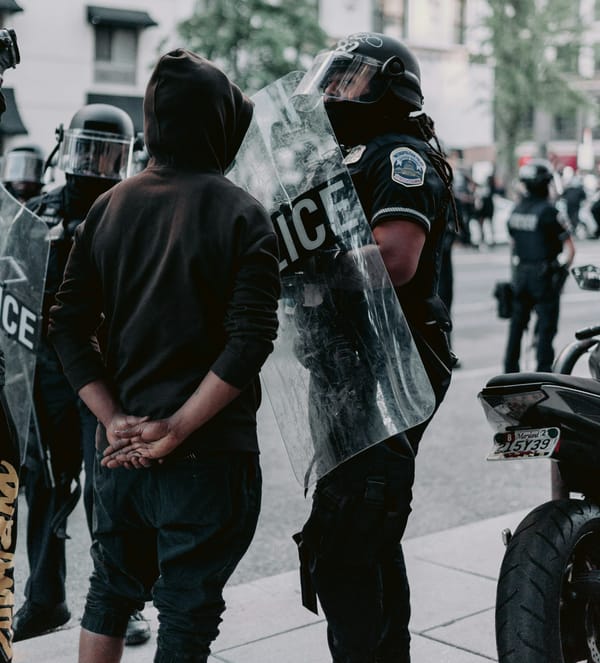
Find your political voice. Then use it.
Discourse isn't evil, and tough political conversations aren't about "reaching across the aisle"


It's easy to feel like our political situation is hopeless—and I'm not here to convince you otherwise. I'm not here to argue that "reaching across the aisle" is how we begin to heal. I'm not here to convince you that putting the right people in charge is just one election cycle away. I'm not here to further the notion that the arc of the universe bends towards justice if we're just patient enough.
What I know to be true is that being able to articulate what's wrong, what's needed, and what your ideas are about the world is a critical first step to making change happen. And I say "articulate" here, with words, not because felt sense doesn't matter. Obviously your feeling of unease with the status quo is important, but for many people, that's where action dies: they feel uncomfortable, they push it down, and they keep it moving.
Putting feelings of discomfort, discontent, and dissent into words makes them a social phenomenon: it communicates feeling outside your body and into your environment, lets others hear and consider it for themselves, allows you to look for resonance. There's a reason activists throughout history have drawn on the concept of "speaking truth to power," and it's because your ability to vocalize dissent is a core component of oppositional movement and political transformation.
What does it mean to have a political voice?
When Hirschman said that we have 3 key political repertoires available (exit, voice, and loyalty), he precisely imagined "voice" as a political act of dissent. But in order to turn your voice into political action, you first have to know what your voice is—what you're trying to say.
Finding your political voice requires some sophisticated skills: aggregating and synthesizing information and observations, differentiating your ideas from others', imagining other timelines and possibilities. But it also leverages what fundamentally makes us human: relating to each other, expressing our needs and desires, and recognizing our individual strengths and limitations in a community context. Those features alone make finding your political voice intrinsically meaningful. But what you do with that voice is where the real action happens.
Finding your own political voice helps you describe and critique your reality, helps you interrogate what's true, and allows you to directly engage with others. But using your political voice is the crucial next step. You might know that you disagree with your racist uncle, but if you aren't quite able to tell yourself why his words are repulsive and his underlying beliefs are regressive, you have a gap in understanding about your own beliefs and commitments, and an even bigger gulf between your status quo and the actions necessary to bring about a different reality.
Political Discourse Isn't the Devil You Think It Is
This is where discourse (the dreaded word 😱) comes in.
What is "discourse" anyway? And what is it for?
Discourse constructs our experience of the world. And deliberation is where discourse moves towards political outcomes. I'll spare you the very lengthy context about the academic fields of study around discourse, but suffice it to say that there's a longstanding interest in the ways that our social use of language and development of vocabulary shape our cognition and our actions.
Why political discourse gets a bad rap
In the age of social media abundance, it's easy for pundits and everyday people to shorthand "the discourse" in a dismissive fashion. "People are doing discourse on Twitter/Bluesky/pick your platform" reflects the exhaustion and despondence with the way netizens are inevitably going to whip themselves into a tizzy about any social or political developments, and start an entire flamewar in the wake of discursive rifts.
This escalation of political disagreement and our suspicion of "cancel culture," among other things, means that "political discourse" as a concept gets a bad rap. That phrase is now mostly synonymous with frivolous in-fighting as internet personalities draw lines in the sand around their personal fiefdoms of social influence. It's not meant to signify a substantive, thoughtful exchange about political developments or policy implications or collective action.
These gripes shift and twist, dividing further and further among ostensible allies until they coagulate again around new identity categories or even more specific, niche political ideologies. Leftist infighting, indeed.
Alternatively, the debate devolves until referees from the sidelines start trying to call for a truce—a gesture of peace, a search for common ground, something that will put an end to the bickering. People touting bipartisan appeal or centrism as the only sensible outcomes, or interjecting "can't we all agree that..." in an effort to seem reasonable, civilized, and mature.
I've never been a specialist in American politics, so it doesn't make sense to me to think about all political debate as binary, or structured around parties or poles of a linear dimension. Naturally, then, I also reject the idea that political debate or talking through political differences should or can or must involve "reaching across the aisle," both on empirical and normative grounds.
Empirically, that makes no sense in most historical and comparative circumstances because, what aisle? Other liberal democracies largely govern by coalition, so there are a multitude of pacts and negotiations that occur to create and constrain governance, not a single ideological divide. (And, to be clear, we in the so-called United States do not have a single ideological divide, either—it's just a useful heuristic fiction to get you to reinvest in a two-party system.)
Normatively, too, bipartisanship and/or centrism obviously cannot be the goal. Without digging further into the weeds on the entire theory of representative government (a long series of diatribes for many future days), you already know and have experienced that a government that represents a "middle way" isn't representing the diversity of perspectives in the voting pool or in the constituency itself. If what you want from a representative government is constituent service, diluted bipartisan consensus won't achieve it.
What political discourse is good for, actually
Contrary to your latent expectations that discourse is really about debate, political discourse does serve a useful function for surfacing diverse political interests, preferences, and commitments. Engaging in discourse with others helps us not only negotiate the political outcomes we want to see (which is where you probably think of this as zero-sum), but also helps us refine our own understanding of what we want, what it might cost, and what its implications might be.
Witnessing others' political discourse can be infuriating, for sure (especially if you think it's ill-considered, reductive, or selfish). But sitting back and not participating in discourse only yields the floor—it doesn't quiet the loudest, most ignorant voices. What political discourse is good for, then, is not only representing and sharpening your own interests and observations, but also contributing to shaping others' perceptions of our shared reality.
Participating in discourse is a political act, and here's why
If you've been made to believe that voting is the most significant political contribution you can make, I'm sorry but also congratulations. That means both that you were brought up in an environment where trust in institutions was high, political stability was taken for granted, and electoral democracy was a norm, AND that your vision of political engagement was problematically and disappointingly stunted to obscure the everyday ways we can be political and achieve political goals.
Centering your political participation around elections and party systems encourages you to reduce your thinking to the frames that are available and represented in candidates already. Just like the loud, obnoxious discourse you perhaps prefer to avoid, it assumes your silence and compliance with platforms dictated and designed by others. You're expected to order from the menu, not create your own dish.
A brief personal history...
I've spent a lot of time thinking about theories of change over the last year. It's not my primary area of expertise. When I was still focused on academic research, I was mainly interested in how authoritarians institutionalize, how information environments shape what we can "know" about politics under authoritarianism, and how to build better ways of incorporating all the information we have—lived experience, quantitative data, anecdotes and impressions—into our models of the political world. For reasons that are artifactual and not actual, studying revolution or regime change is treated as a different specialty. It's something I spent a lot of time on in earlier parts of my academic career, when I asked more questions about social movements and political organization, and now it's something I've returned to with a different lens.
When I was still doing my first master's at the place that shall not be named, a small group of us spent so much time talking with and thinking alongside Jenny Mansbridge—taking all her courses, getting coffee or snacks, attending workshops strategizing around the then-very-real threat of Tea Party politics. Jenny's oft-repeated take was that we should make a point of showing up to protests with the xkcd-style picket sign, [citation needed]. That advice unfortunately aged both well and also very, very badly.
The few of us gathering for these regular meetings wanted a deeper theoretical basis than we were getting in our prescribed policy courses—not just what to do about politics or economics or social conditions, but why. And for me, Jenny's assignments to think through feminist perspectives on direct democracy and deliberation became core components in my understanding of politics, and central to how I approach bridging my own (anarchist) orientation with the more liberal institutional leanings among those around me.
At the time, so much of my thinking was tied up in Foucauldian ideas about how power weaves its way insidiously through all of us—our actions, our institutions, our thoughts and bodies—and how that concept of power felt incompatible with any practical implementations of deliberation or creating a public sphere.
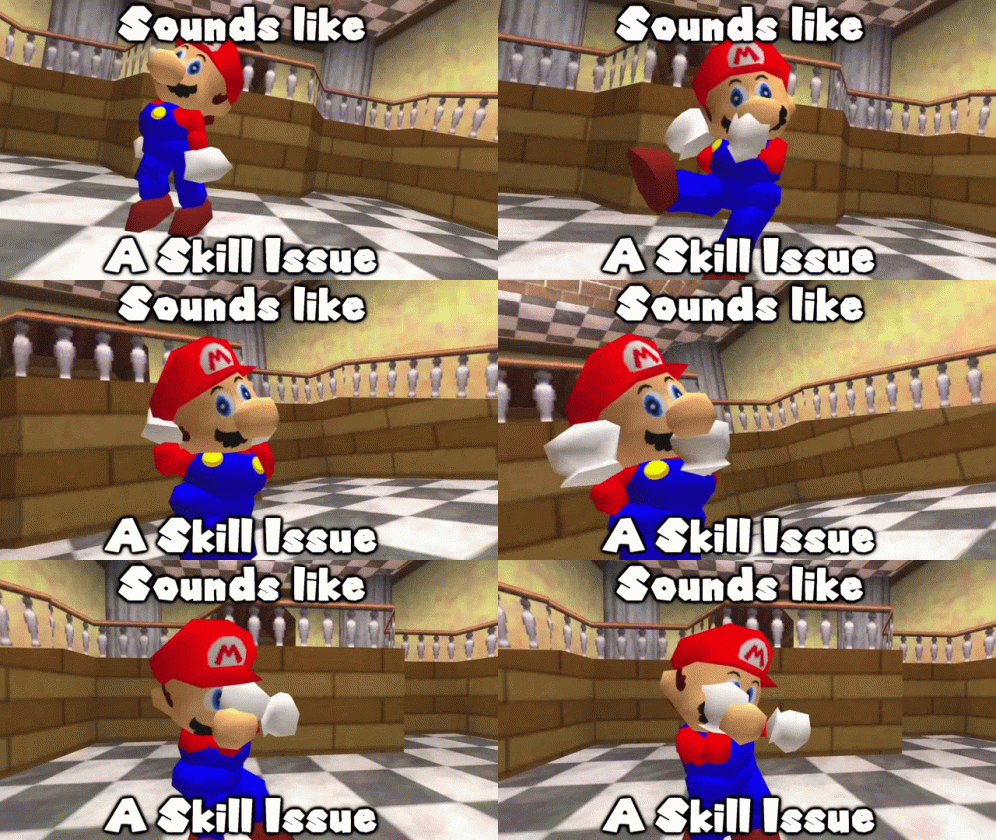
To be clear, I still worry about those things and I think we should. But another part of me thinks... skill issue.
Participatory democracy isn't the default, actually
Indulge me for a moment in a brief detour through one corner of democratic theory, specifically about participatory democracy, and even more specifically, about Carole Pateman.
Pateman's Participation and Democratic Theory (1970) challenged a prevailing anxiety that had settled in after academic and policy fields adopted a procedural, Schumpeterian definition of democracy: what if mass participation by (uneducated, presumably lower-class) citizens in the democratic system leads to poor political outcomes, or worse yet, instability in the democratic equilibrium itself?
Pateman summarizes observations at the time of how a heterogenous society could still have a democratic system as follows:
In short, limited participation and apathy have a positive function for the whole system by cushioning the shock of disagreement, adjustment and change. [7]
For "classical" theorists of democracy, she argues, the primary functions of democracy occurred around competition for votes among leaders, not as a function of the electorate or their preference formation itself. Summarizing Dahl, she calls attention to the "dangers" that increasing participation might pose:
The lower socio-economic groups are the least politically active and it is also among this group that 'authoritarian' personalities are most frequently found. Thus, to the extent that a rise in political activity brought this group into the political arena, the consensus on norms might decline and hence polyarchy decline. [10]
This probably sounds familiar, and perhaps you have expressed similar sentiments: that the reason the US is presently in democratic decline is due to uneducated people participating in politics (e.g., voting), when they do not share liberal democratic norms of governance. It's an enticing argument, but one that relies on the specter of class divisions or the notion that supporting democratic practice is somehow a higher-order ideology than alternatives.
Pateman returns to earlier political theorists (Rousseau, Mill, etc.) to re-examine the political obligations of individuals, as well as the ways they are shaped into both public and private citizens, and her intellectual legacy more broadly levels feminist critiques at liberal theory, examining who is often excluded (women, people of color) from conceptions of our political contracts.
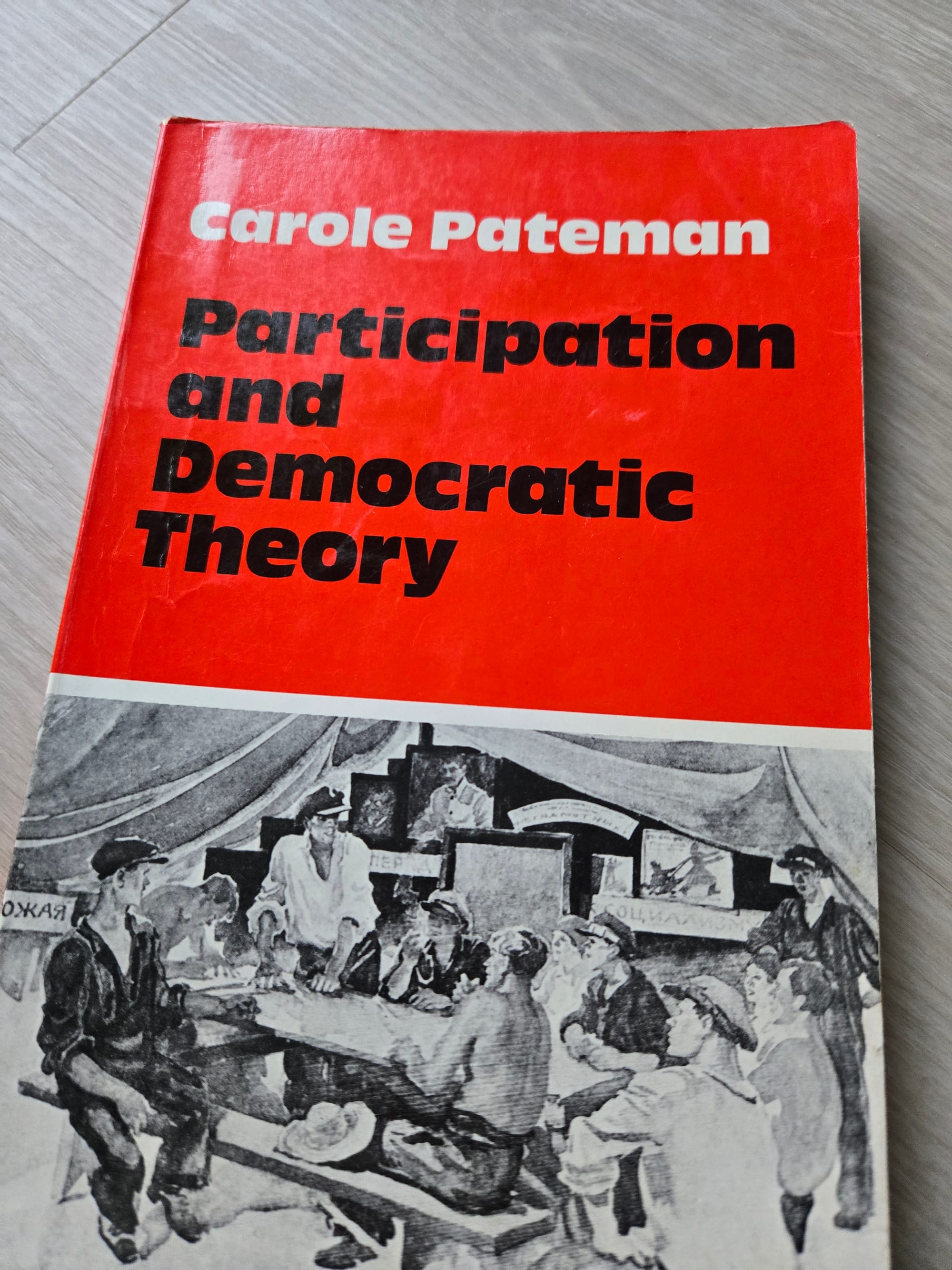
The rest of Participation and Democratic Theory investigates participation in workers' groups in Yugoslavia, including the social dimensions along which workers are invited to decision-making. Ultimately, though, she concludes by highlighting how regressive—even anti-democratic—our theories of democratic participation are and were, that they were predicated (often) precisely on non-participation by certain segments of society.
Participation itself, she argues, serves to educate people about how the system functions and the outcomes they desire. This is in part what I mean when I say that the pitfalls of discourse and deliberation are, or might be, a skill issue. But what should participation look like, and under what auspices?
How we participate, and what we participate in, shapes our political outcomes
This is where we come back to Mansbridge—and I promise this diversion will soon take us back to what you can be doing. Jenny had a book come out in 1980, one of her more famous, called Beyond Adversary Democracy. Examining small-scale political and social groupings as they made decisions (e.g., town meetings and intervention services), she argued that drives for consensus could be just as constraining as requiring adversarial debate. Really knowing the other people involved in your political and social decision-making, contending with them face-to-face, however, served an important political function for acknowledging the implications of our collective decision-making.
Ultimately, Beyond Adversary Democracy doesn't paint an overly rosy picture of consensus-based political practices that you might expect, and Mansbridge herself notes the ways that unequal political power and social standing mean that some are less able to adequately participate in political processes and deliberation.
Both Pateman and Mansbridge have feminist critiques of our democratic, or even small-scale consensus-based, political systems predicated on concerns about underlying inequality and how it will manifest in those systems. If we take Pateman seriously, though, that participation is itself a learning opportunity, and if we find Mansbridge credible in saying that small-scale deliberative decision-making isn't utopic, we should conclude that participating in political processes itself can't be the entry point. Rather, it requires preparation, and is itself an object of political work.
What this means for you
There are a lot of extant critiques of direct democracy and deliberative processes even beyond these feminist ones, some of which I share. Deliberative processes tend not to scale (i.e., we couldn't do town hall meetings at the level of the nation-state) and are time-inefficient. They don't resolve Foucauldian concerns about the ways that power moves through us and shows up even in our most benevolent attempts to increase participation and ensure positive political outcomes: those who had power or access to resources will likely be better able to participate, more able to articulate their needs and goals, and might even receive more deference in the end.
But none of that means that developing—and using—your own political voice isn't important. On the contrary, it means that it's a lot more work than you might imagine. As someone not particularly committed to the status quo or even the normatively imagined ideal of liberal democracy, you might be confused to see me argue from a position of deliberative practice. But what I know is, even though deliberative systems might not scale, our skillsets can and do.
If you develop the skills to understand political processes and actors, and invest in your own political education to understand your needs and desires, and practice articulating your political visions in social settings, these skills can and will ultimately serve you irrespective of the systems we're living under. Whether you have access to democratic institutions now or in the future, whether you're organizing in small groups to effect direct political action, whether you're living in a repressive system and carving out your own pockets of liberation—in all of these settings, discursive practice and deliberative process can serve you.
We can never have complete tabula rasa that obviates an attentiveness to social power dynamics and sets us up for a perfectly deliberative society. And certainly, because of inequality in power and positionality, you have the power to engage in discursive harm as you start to find your political voice, and others have that power against you in turn. But developing your political voice nevertheless helps you contend with not having innate power; it's a stepping stone to identifying and confronting power itself. Practicing using that voice is the only way you can develop the skill for political deliberation.
So I need a political voice. Now what?
To recap: I'm not saying here that we should all learn how to articulate our views until we find things we agree upon. I'm not saying that we should take our status quo, or even our prior reliance on democratic institutions, for granted as inevitable or desirable, either. Rather, when you articulate your views and commitments clearly to yourself, and others can and do as well, we can refine what we each believe, we can re-articulate and renegotiate. This process of articulation and refinement invites us into shared discursive space to figure out whether and how we can live and work together as a society, for one thing. And it is fundamentally politics itself, whether we have electoral institutions or not.
Looking ahead
These suggestions might seem abstract and long-term in their orientation, but the short-term is the most important right now because the Democrats aren't going to save you (or any of us, in any country). If you aren't articulating your commitments out loud to yourself and your comrades, you aren't discovering places where you naturally disagree and aren't adequately testing your trust of each other. That alone is going to matter hugely in the immediate term, because so many political risks and risks of harm in general accrue to us from the people who are closest to us.
So what can you do? A few suggestions for now:
- Invest in your political education
- Observe when you agree, disagree, or don't understand a political position being taken. Where does it land for you, what feels wrong or right about it, what further information do you need to understand it?
- Read, listen, and watch. Consuming political information and news isn't just critical for safety reasons and staying up-to-date with developments, it's also key for developing your own understanding and situating your ideas in cultural and social context.
- Practice intervening in political discourse
- Start close to home, with trusted friends and allies. Gently question or ask for more details about statements they make, or invite others to share their political commitments with you. Offer your own and be open to feedback and questions about them.
- Explore what it feels like to intervene when you have strong disagreement, and practice feeling more comfortable with conflict.
- Hone your discursive skills by staying in the conversation
- Over time, work up to longer conversations with friends (or adversaries 😈) where you expect to disagree politically, ideologically, or semantically. Explore the contours of your disagreement and resist the urge to shut down the conversation with "things we can all agree on."
- Seek out support and opportunities for learning
- You don't have to do this alone, and in fact, the non-hierarchical future depends on us doing this together. So seek out people, communities, and spaces that invite your political practice and make space for you to develop your voice.
If you want help and community as you embark on your journey to find a political voice and practice using it, check out political peer mentorship opportunities. Whether you need 1:1 guidance, facilitation for your community conversations, or structure to your political education process, you can get the support you need.